The Great Wall of China runs across the north of the country, from the Yalu River on the North Korean border to the edge of the Gobi in Gansu. Its best-known line, built under the Ming dynasty, measures 8,851.8 km from Hushan near Dandong to Jiayuguan, and the walls of every dynasty together total 21,196 km across 15 provinces.
It is not one wall but a network of walls, built, abandoned and rebuilt over about two thousand years, often in parallel lines. Most visitors see it in one place: the mountains north of Beijing, where several restored sections lie within a day trip of the capital.
Where is the Great Wall of China located?
In 2012 China’s State Administration of Cultural Heritage published the results of a survey of the walls of every dynasty. It measured 21,196.18 km of them in 15 provinces, autonomous regions and municipalities: Beijing, Tianjin, Hebei, Shanxi, Inner Mongolia, Liaoning, Jilin, Heilongjiang, Shandong, Henan, Shaanxi, Gansu, Qinghai, Ningxia and Xinjiang.
The Ming wall, the brick-and-stone wall with watchtowers seen in most photographs, crosses ten of them. A 2009 survey traced it through Liaoning, Hebei, Tianjin, Beijing, Shanxi, Inner Mongolia, Shaanxi, Ningxia, Gansu and Qinghai. On a map it makes a long arc across the north, from the coast near Korea to the Hexi Corridor, the narrow strip of oases that led to the Silk Road.
Where does the Great Wall start and end?
Both ends have more than one answer, which is why a search for “the end of the Great Wall” turns up different places.
The eastern end: Hushan or Old Dragon’s Head
The official eastern end of the Ming wall is Hushan, or Tiger Mountain, about 15 km northeast of Dandong in Liaoning, on the Yalu River facing North Korea. A survey led by the architectural historian Luo Zhewen in the late 1980s and early 1990s identified the ruins there as the end of the line. About 1,250 m of wall was rebuilt in 1992, and China’s 2009 measurement of the Ming wall starts here. Some Korean historians dispute that the Hushan wall was part of the Ming defenses at all.
The end most people picture is further west, at Shanhaiguan in Hebei. Shanhai Pass is often described as the eastern end of the Great Wall, and its gate is known as the First Pass Under Heaven. About 5 km southeast of the old town, at Old Dragon’s Head (Laolongtou), the wall runs into the Bohai Sea, with a stone wall reaching about 22 m into the water. Much of what stands there was restored from 1985.
The western end: Jiayuguan and the Han walls beyond
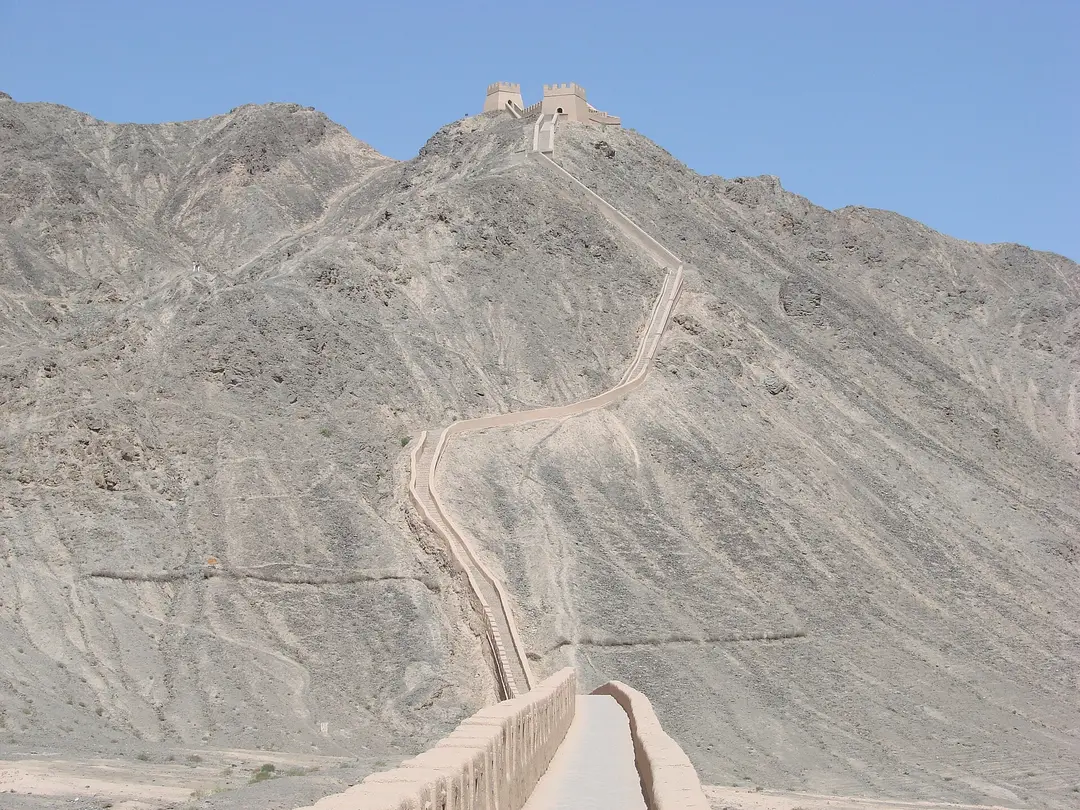
The Ming wall ends at Jiayu Pass (Jiayuguan) in Gansu, a fortress begun around 1372 about 6 km southwest of the modern city of Jiayuguan. Britannica and the 2009 survey both put the western end here.
Older walls go further west. From the 2nd century BC the Han dynasty built walls and beacon towers into the desert to guard the Silk Road. Near Yumen Pass, the Jade Gate, about 90 km by road northwest of Dunhuang, sections still stand that were built from layers of sand and reeds or willow branches. Local heritage staff say these Han walls and beacons run for nearly 200 km around Dunhuang.
Is the Great Wall in Beijing?
Yes, but in the mountains of the municipality, not in the city. The Great Wall in Beijing is 520.77 km long, in 461 recorded sections across six outer districts, and none of it lies inside the ring roads. Less than 5% has been restored and opened as scenic areas. The city plans to open more than 10% by 2035.
Beijing is still the easiest place to see the wall, because several restored sections lie 1 to 3 hours’ drive from the center. Other cities with wall on their doorstep are Qinhuangdao (for Shanhaiguan), Dandong (for Hushan) and Jiayuguan, but they are a train ride or a flight from the main tourist routes.
Which Great Wall sections can you visit near Beijing?
Distances and drive times are from central Beijing and vary between sources, so we give the range. Traffic on weekends and holidays can add an hour.
| Section | Distance and drive | Cable car | Condition | Suits |
|---|---|---|---|---|
| Juyongguan | 50–60 km, about 1–1.5 hours | No | Rebuilt fort with a steep 4 km wall loop | A short trip; history |
| Badaling | 70–80 km, 1–2 hours; about 20 minutes by train | Yes | Fully restored; very busy | Travelers without a car |
| Mutianyu | About 70 km, 1.5–2 hours | Yes, plus chairlift and toboggan | Restored, wooded | First visits, families, older travelers |
| Huanghuacheng | 60–75 km, about 1.5 hours | No (boats on the lake) | Lakeside wall, partly underwater | Fewer crowds, lake views |
| Simatai | About 120 km, 2–3 hours | Yes | Partly restored; only part open | Night visits with Gubei Water Town |
| Jinshanling (Hebei) | 125–155 km, 2–3 hours | Yes | Part restored, part original | Hikers and photographers |
| Jiankou | 75–100 km, 2–3 hours | No | Unrestored ruin, not open | Not a visitor site |
A few notes on each:
- Juyongguan is the closest section. It is a fortified pass in a valley, with the wall climbing steeply up both sides; the full loop is more than 1,500 uneven steps.
- Badaling was the first section opened to tourists, in 1957, and is the busiest. Tickets are real-name and capped at 65,000 a day. High-speed trains from Qinghe and Beijing North reach Badaling Great Wall station in about 20 minutes, around 800 m from the entrance.
- Mutianyu has 22 watchtowers along about 2.25 km of open wall. See our Mutianyu guide for tickets and the lifts.
- Huanghuacheng is the only section in Beijing that meets a lake, and three stretches of it run under the water.
- Simatai is entered through Gubei Water Town and is known for lantern-lit evening visits. Parts of the wall have been closed for repairs in recent years; towers 10 to 12 on the eastern side reopened in October 2026.
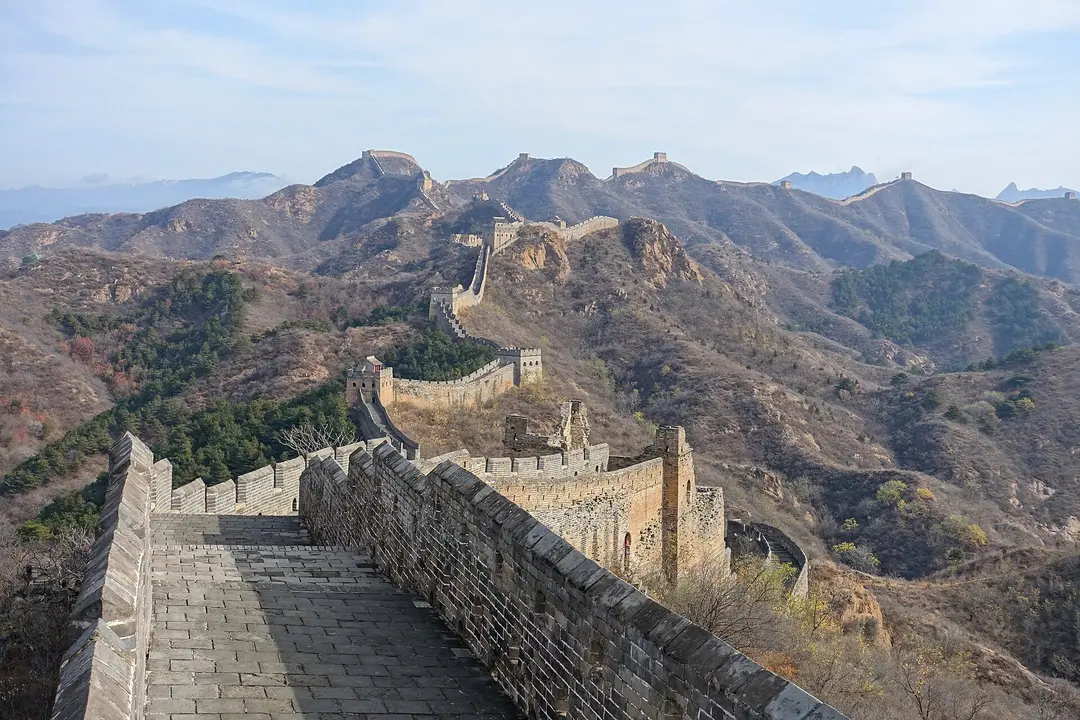
- Jinshanling lies just over the border in Hebei, with 67 towers on 10.5 km of ridge. The restored stretch near the entrance gives way to original, less repaired wall towards Simatai.
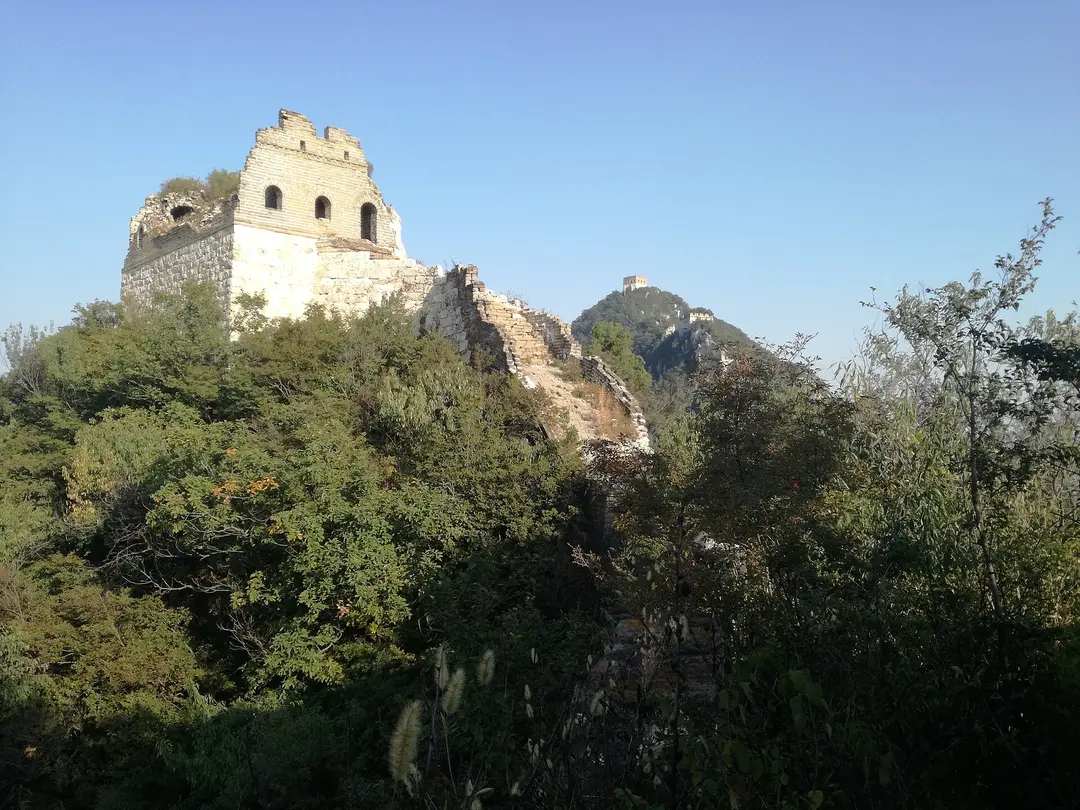
- Jiankou is the steep, crumbling stretch in many famous photographs. It is not maintained and not open; our guide to walking the Great Wall explains the rules.
Which section of the Great Wall is best?
For a first visit, Mutianyu. It is restored, the scenery is green rather than bare, and you can ride up and toboggan down. Badaling suits anyone who wants to go by train and does not mind crowds. Jinshanling suits fit walkers who want long views and original stonework, and it repays the longer drive. Simatai is the one to choose if you want to see the wall after dark.
If time is short, Juyongguan gives you the wall and a fortress in half a day. If you have a day free and dislike crowds, Huanghuacheng is quieter than the big three.
Can you see the Great Wall in Shanghai, Xi’an or Hong Kong?
No. Shanghai and Hong Kong are not among the 15 provinces the wall crosses. From Shanghai, the realistic option is to add Beijing to your trip; the fastest trains take about 4 hours 20 minutes, as our Beijing to Shanghai guide explains.
In Xi’an, the wall around the old city is the Xi’an City Wall, a Ming city wall rather than the Great Wall. Shaanxi does have 1,838 km of Great Wall from several dynasties, but its 1,170 km of Ming wall is in the far north of the province, mainly around Yulin and Yan’an, where the Zhenbeitai tower is the best-known sight.
If you would like a driver for one of the quieter sections, a Hosted China host can arrange a car and driver.