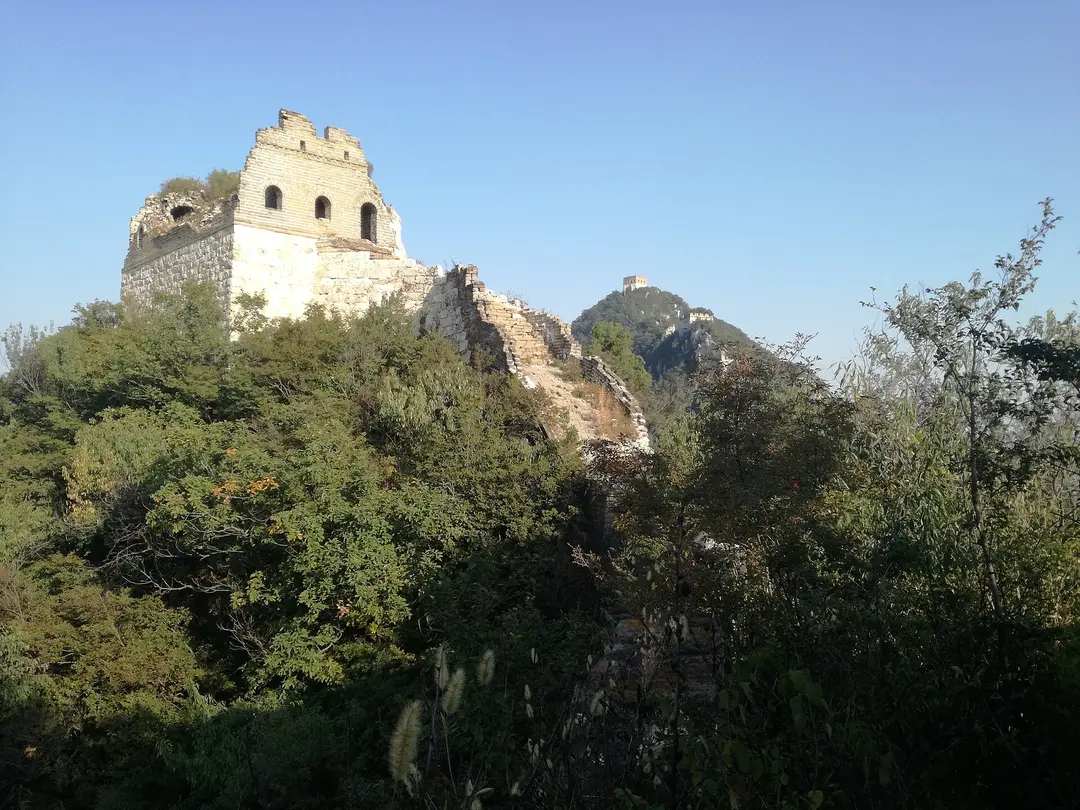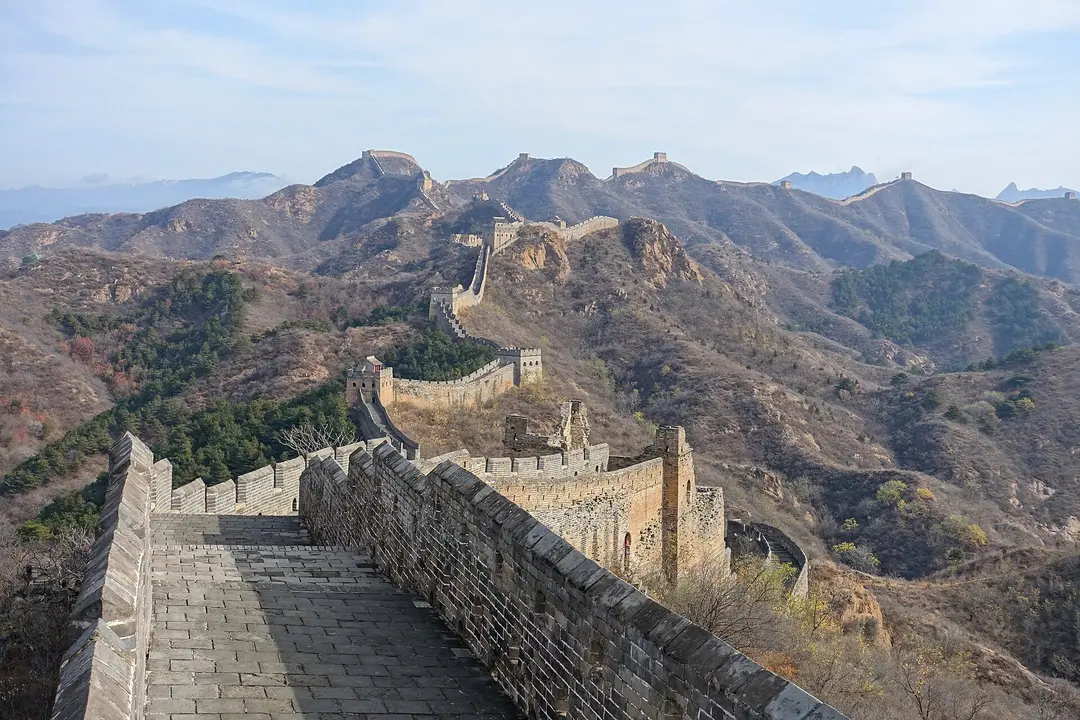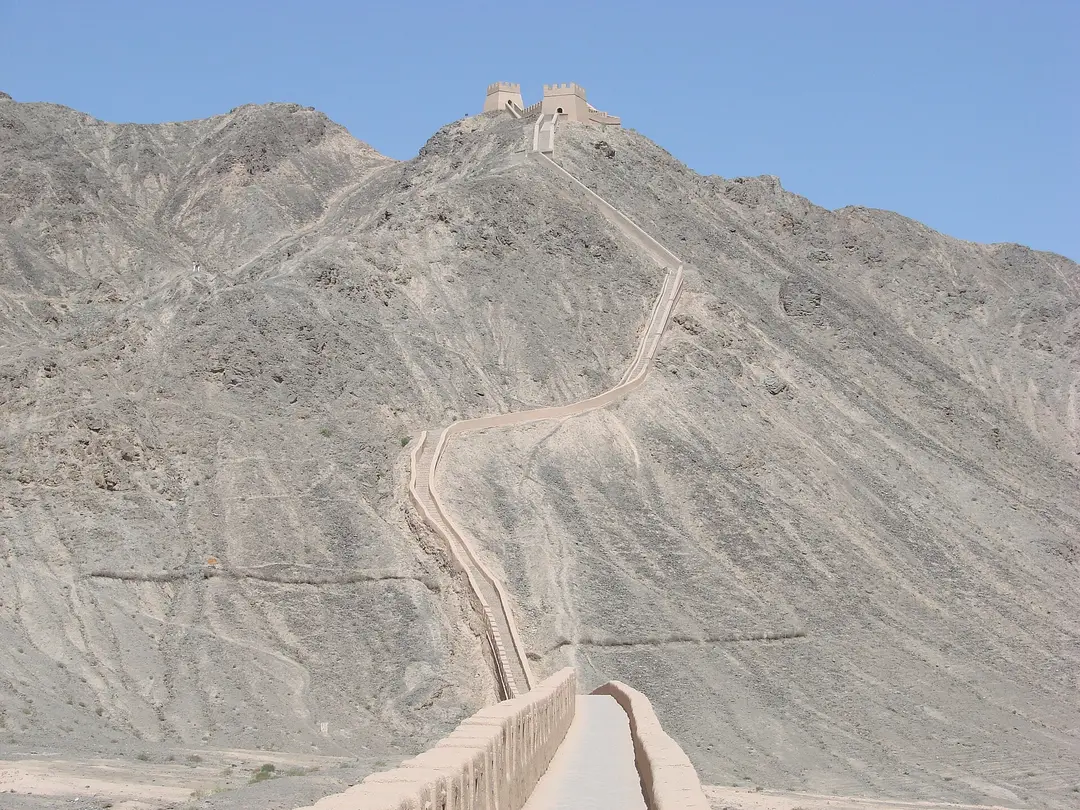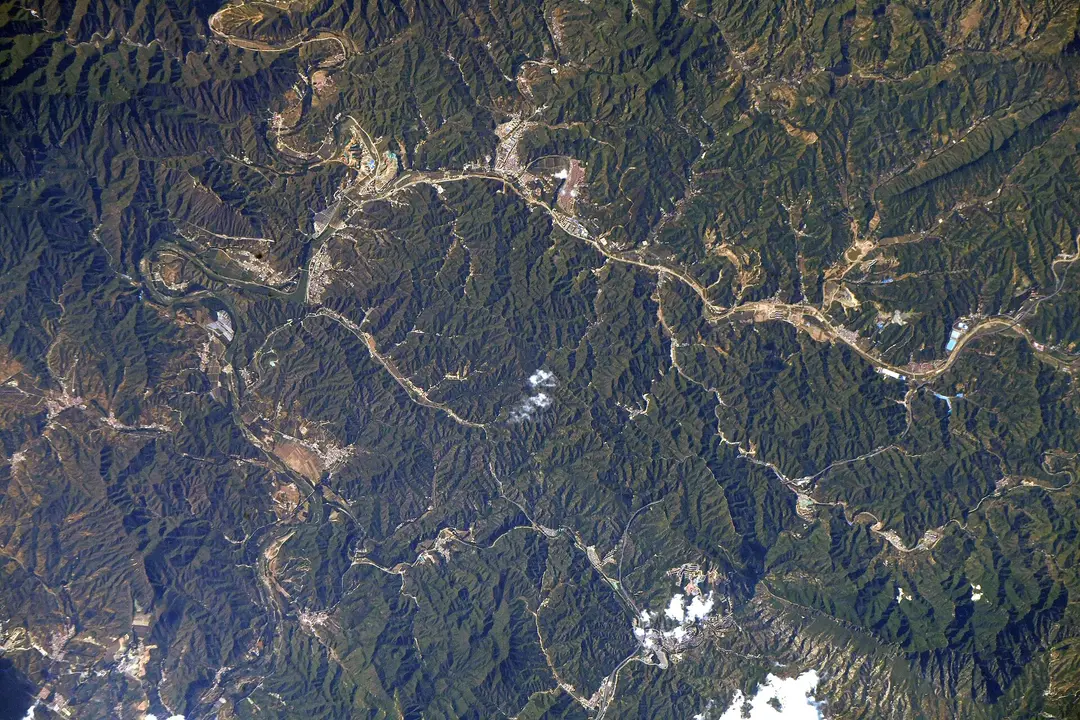
You cannot see the Great Wall of China from the Moon, and you can barely see it from low Earth orbit. NASA says it is “questionable whether you can see it with the unaided eye from space,” and astronauts on the International Space Station, about 400 km up, have only captured it with long telephoto lenses.
The idea that the wall is the one man-made object visible from space is older than spaceflight itself. Here is what astronauts have actually reported, why the wall is so hard to spot, and where you can see it properly, from the ground.
Is the Great Wall visible from space with the naked eye?
Almost never, according to the people who have looked. China’s first astronaut, Yang Liwei, orbited Earth 14 times on Shenzhou 5 in October 2003. Asked about the view on China Central Television after landing, he said: “But I didn’t see the Great Wall.”
American astronauts have said much the same. Jeffrey Hoffman, who passed over China many times on his orbital flights, told Scientific American: “I never saw the wall.” ESA astronaut Alexander Gerst, on the space station in 2018, described it as “next to impossible with the naked eye.”
A few astronauts, including Eugene Cernan and Ed Lu, have said they did see it from low orbit, usually when the sun was low and the wall cast long shadows. So “never” is too strong. “Very rarely, and only in perfect conditions” is closer to the record.
The problem is not mainly length. It is width and color. Most of the wall is less than about 6 m wide; Britannica puts the Ming wall at about 5.8 m across the top and 6.5 m at the base. It is built from local earth and stone, so it is roughly the same color as the hills it crosses. NASA’s chief scientist for Earth observation at the time, Kamlesh Lulla, said the wall is very hard to pick out in astronaut photos for exactly this reason.
Can you see the Great Wall from the ISS?
With a camera and a long lens, yes. The first photo NASA confirmed was taken on November 24, 2004, by Leroy Chiao, commander of ISS Expedition 10. He used a digital camera with a 180 mm lens and caught a stretch of wall in central Inner Mongolia, about 200 miles (320 km) north of Beijing. NASA’s own account notes that Chiao “didn’t see the wall, and wasn’t sure if the picture showed it.” A second photo he took on February 20, 2005, with a 400 mm lens may also show it.
Later astronauts have tried with even more magnification:
- Alexander Gerst (ESA), 2018: an 800 mm lens. He posted the photo at the top of this page, asking: “What do you think, is this it?”
- Thomas Pesquet (ESA), 2021: the longest lens on board, 1,150 mm. He said the wall is not visible to the eye, so he navigated by landmarks and shot “blind,” and the wall appears in the middle of his frames.
Radar works better than eyesight. NASA notes that sections of the wall show up readily in radar images, such as those taken by the Spaceborne Imaging Radar on Space Shuttle Endeavour.
How far away is space? Low orbit vs the Moon
“Space” covers a huge range of distances, and that is where much of the confusion starts.
| Viewpoint | Distance from Earth’s surface | What a 6 m wide wall looks like |
|---|---|---|
| Edge of space (Kármán line) | About 100 km | Like a strip 6 cm wide seen from 1 km away |
| International Space Station | 370–460 km | Like a strip about 1.5 cm wide seen from 1 km away |
| Landsat satellites | About 705 km | Like a strip under 1 cm wide seen from 1 km away |
| The Moon | 384,400 km on average | Like a strip 0.016 mm wide seen from 1 km away, far finer than a human hair |
The comparisons are simple geometry: the wall’s width divided by the distance. The Moon is almost 1,000 times farther away than the space station, so a wall that is a struggle to see from orbit has no chance at all from there.
Roads, airports and cities are easier to spot from orbit than the wall, even when narrower, because they contrast with the ground around them. NASA notes that astronauts in low orbit can see cities, highways, bridges, dams and airports.
Can you see the Great Wall from the Moon?
No. The Apollo astronauts who stood on the Moon described seeing Earth as a whole: Neil Armstrong recalled continents, lakes and white patches on blue, but no man-made structures. Alan Bean, of Apollo 12, said: “No man-made object is visible at this scale.”
NASA’s 2005 article on Chiao’s photo is just as direct: the wall “certainly isn’t visible from the Moon.”
Where did the myth come from?
From writers who had never been to space, and in some cases never to China. The earliest known version comes from the English antiquarian William Stukeley, who wrote in a private letter in 1754 of “the Chinese wall, which makes a considerable figure upon the terrestrial globe, and may be discerned at the Moon.”
The claim was popularized in 1932 by a Ripley’s Believe It or Not! cartoon, which called the wall “the mightiest work of man, the only one that would be visible to the human eye from the moon.” NASA’s 2005 article notes that the belief was in print by 1938, decades before anyone could check it.
Yang Liwei’s comment in 2003 drew wide attention because it came from China’s first astronaut. The Register reported in 2004 that Chinese school textbooks repeating the claim would need to be revised.
Can you see the Great Wall on Google Maps?
Yes. The satellite views of Google Maps and Google Earth use satellite and aerial images that are far more detailed than anything the naked eye can make out from orbit, and the wall can be traced in them.
That imagery is useful for research as well as curiosity. In 2011 an expedition led by the Great Wall researcher William Lindesay used Google Earth to locate and then document about 100 km of wall remains in Mongolia’s Gobi Desert, according to National Geographic. For an overview of where each section runs, see our Great Wall map.
Where to actually see the Great Wall near Beijing
Not from the city itself. The wall runs through Beijing’s mountainous outer districts, about 520 km of it in total, and the nearest open sections are about an hour or more from the center by road. You cannot see it from Shanghai at all: the wall does not come anywhere near the city, and the fastest trains to Beijing take about 4 hours 20 minutes.
The two easiest sections for a day trip:
- Mutianyu. About 70 km northeast of the center, 1.5 to 2 hours by car. It is restored and wooded, with a cable car, a chairlift and a toboggan down.
- Badaling. The best-known section, northwest of the city. High-speed trains from Qinghe or Beijing North stations reach Badaling Great Wall station in about 20 to 40 minutes.
For longer hikes on less restored wall, see can you walk the Great Wall. For the history behind what you are standing on, read our Great Wall facts, and for fitting a wall day into your trip, see our Beijing guide. If you would rather have a car and driver waiting at your hotel, a Hosted China host can arrange one.