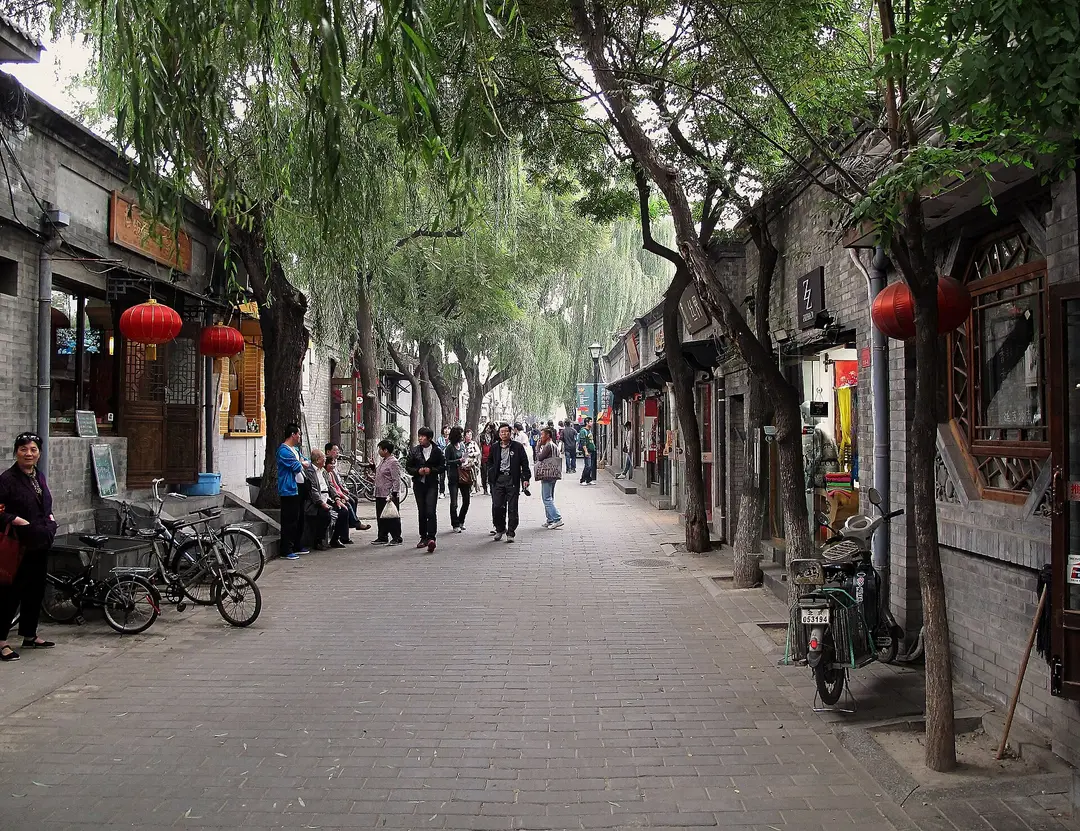
Hutongs are the lanes of old Beijing: narrow alleys of grey brick courtyard houses, many with roots in the Yuan and Ming dynasties. Large parts of the old city were rebuilt in recent decades, but the area north of the Forbidden City, around the Shichahai lakes and the Drum and Bell Towers, still has a dense web of them.
This is a place to walk rather than tick off. Some lanes are lined with cafes and shops. Others are quiet residential streets with bicycles, laundry and neighbors chatting outside their gates. Allow half a day and go slowly.
The area in brief
Nanluoguxiang is a lane of about 800 meters running north to south, dating from the Yuan dynasty. It is the best-known hutong in the city and the most commercial, with snack shops, boutiques and cafes. Side lanes such as Mao’er Hutong and Ju’er Hutong branch off it and are far calmer.
The Drum and Bell Towers stand at the north end of Beijing’s central axis, a few minutes’ walk from each other. Both were built to keep time for the city. You can climb both for a view over the rooftops; the stairs are steep.
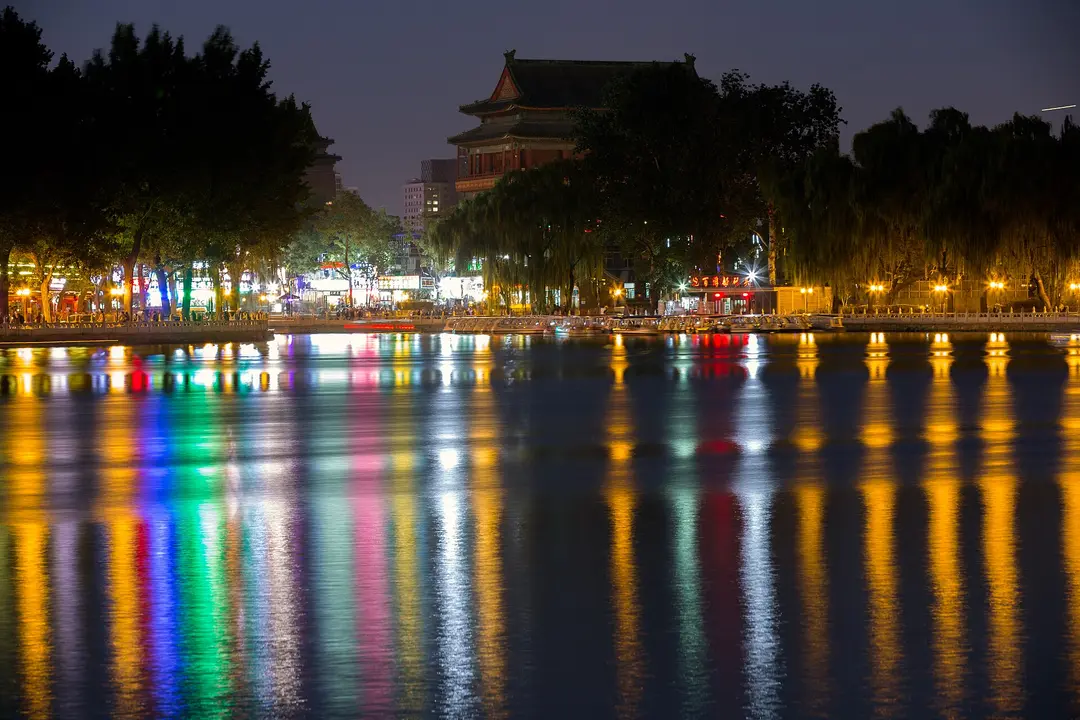
Shichahai is a chain of three lakes, Qianhai, Houhai and Xihai, just west of the towers. In the Yuan dynasty this was the northern end of the Grand Canal. Today the shores are lined with willows, bars, teahouses and restaurants. Prince Gong’s Mansion, one of the city’s best-known princely residences, is a short walk from the south shore of Houhai.
A walking route
Start at Nanluoguxiang subway station (Lines 6 and 8) and walk north up Nanluoguxiang. Turn into one or two of the side lanes on either side to see the residential hutongs.
At the north end, turn left on Gulou East Street and walk west to the Drum Tower. Buy a joint ticket and climb the Drum Tower, then cross the small square to the Bell Tower.
From the towers, walk southwest through Yandai Xiejie, a short angled lane of about 230 meters with old shopfronts, to Yinding Bridge, the small stone bridge between Qianhai and Houhai. From here you can follow the shore of Houhai west or of Qianhai south. Shichahai station on Line 8 is close by, and Beihai North on Line 6 is at the south end of Qianhai.
The route is about 3 km on foot, flat all the way, and takes about three to four hours with stops.
Tower hours and tickets
The Drum and Bell Towers open at 9:30. From late October to spring they close at 16:30; in the warm season they close at 17:30. Ticket sales stop 30 minutes before closing. The two official city pages give slightly different start dates for the summer season, so check the 北京钟鼓楼 WeChat account if you are visiting in March or April.
The Drum Tower costs ¥20, the Bell Tower ¥10, and a joint ticket ¥30. The Drum Tower’s ground-floor exhibition hall is closed on Mondays, except public holidays. The Bell Tower reopened to visitors in July 2026 after a closure.
On the lakes
From spring to autumn you can rent a boat on Qianhai or Houhai. In August 2026 a four-person pedal boat cost about ¥180 an hour and a rowboat about ¥80 per person for 30 minutes; prices are posted at the docks. In winter the lakes freeze and become skating rinks.
The lakeshore is busiest from early evening, when the bars and restaurants open and some have live music. There is no formal show; the appeal is the walk and the lights on the water.
Tips
These are lived-in streets. Keep to the lanes, do not photograph people at their doors without asking, and give way to scooters and delivery bikes, which move quickly and quietly.
Most shops and stalls take Alipay and WeChat Pay. Set them up before you go with our paying in China guide.
For hutong snacks and where to eat nearby, see the Beijing food guide.
Checked on 29 October 2026. Opening times and ticket rules change; confirm on the official site before you go.