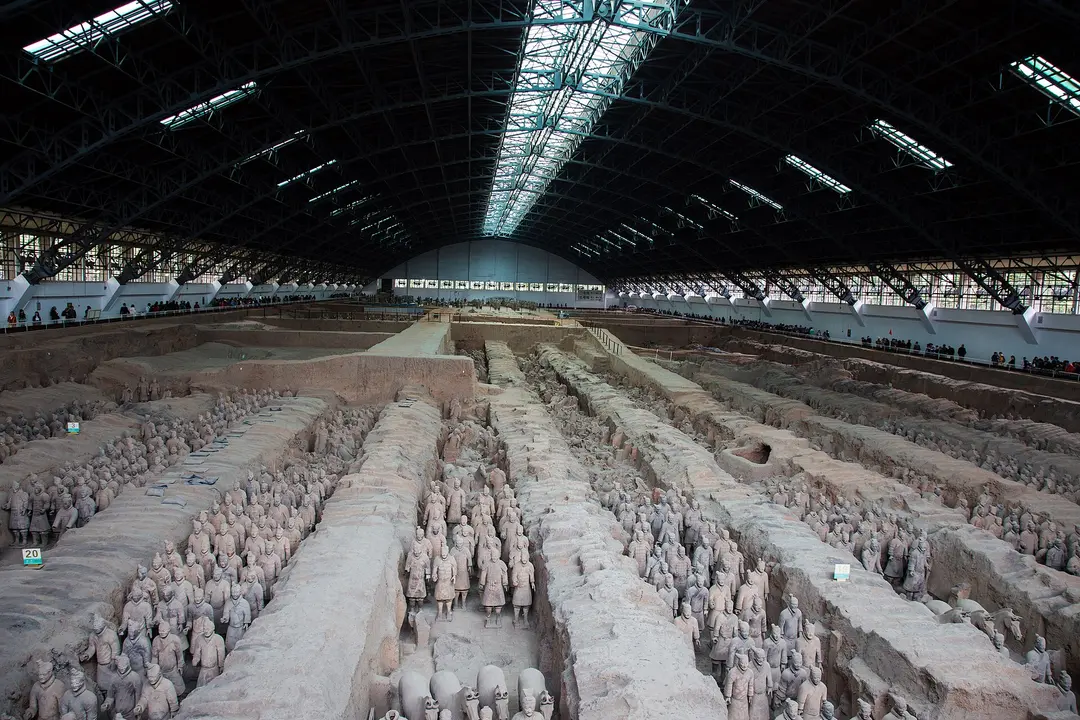
The Terracotta Warriors are an army of an estimated 8,000 life-size clay soldiers, with horses and chariots, buried more than 2,200 years ago to guard the tomb of Qin Shi Huang, the first emperor of a unified China. Only about 2,000 have been excavated since farmers found the first fragments in 1974. They stand in three pits on the eastern edge of Xi’an, in Shaanxi province.
Figures below come from the Emperor Qinshihuang’s Mausoleum Site Museum, which runs the site, and from UNESCO, Britannica, National Geographic and Smithsonian. Where they disagree, we give both numbers.
What are the Terracotta Warriors?
They are part of the burial complex of Qin Shi Huang (259–210 BCE), the ruler who conquered the last rival states in 221 BCE and imposed one system of writing, money and weights across China. UNESCO dates the start of work on his tomb to 246 BCE, when he was still king of Qin, and says it went on until his death.
The army is only one piece of that complex. The museum’s protected area covers about 56 square kilometers, and UNESCO counts nearly 200 accompanying pits around the burial mound. Other pits hold bronze chariots, clay civil officials and acrobats. The soldiers are the best known because they are the most numerous and the most complete.
How many Terracotta Warriors are there?
The usual answer is about 8,000, the figure Britannica, National Geographic and Live Science give. Smithsonian magazine and a 2014 National Geographic report use about 7,000. Both are estimates, because most of the army is still underground.
The museum works from the density of the figures it has already dug up. It estimates about 6,000 figures and horses in Pit 1 and more than 1,300 in Pit 2, and Pit 3 holds 72. Together that is roughly 7,400 figures and horses, which explains why both 7,000 and 8,000 are quoted.
| Pit | Size (museum figures) | What is in it | Found |
|---|---|---|---|
| Pit 1 | 230 x 62 m, 14,260 m² | About 6,000 figures and horses, mainly infantry and chariots in long corridors | March 1974 |
| Pit 2 | 124 x 98 m, about 6,000 m², L-shaped | More than 1,300 figures and horses: archers, cavalry, chariots and infantry | April 1976 |
| Pit 3 | 28.8 x 24.6 m, 520 m², U-shaped | 72 figures and horses; thought to be the command post | May 1976 |
| Pit 4 | Not on display | Empty; it appears to have been left unfinished | — |
The number actually excavated is far smaller. Smithsonian magazine put it at more than 2,000 in 2020, and Live Science gave about 2,000 in 2022. Digging continues slowly in Pit 1: its third excavation, begun in 2009 over about 430 m², had produced more than 220 warriors by early 2023, according to the Shaanxi cultural relics bureau.
Where are the Terracotta Warriors?
The pits are in Lintong District, at the northern foot of Mount Li, about 35 km from central Xi’an according to UNESCO. They lie about 1.5 km east of the emperor’s burial mound, and the army faces east, toward the states Qin had conquered.
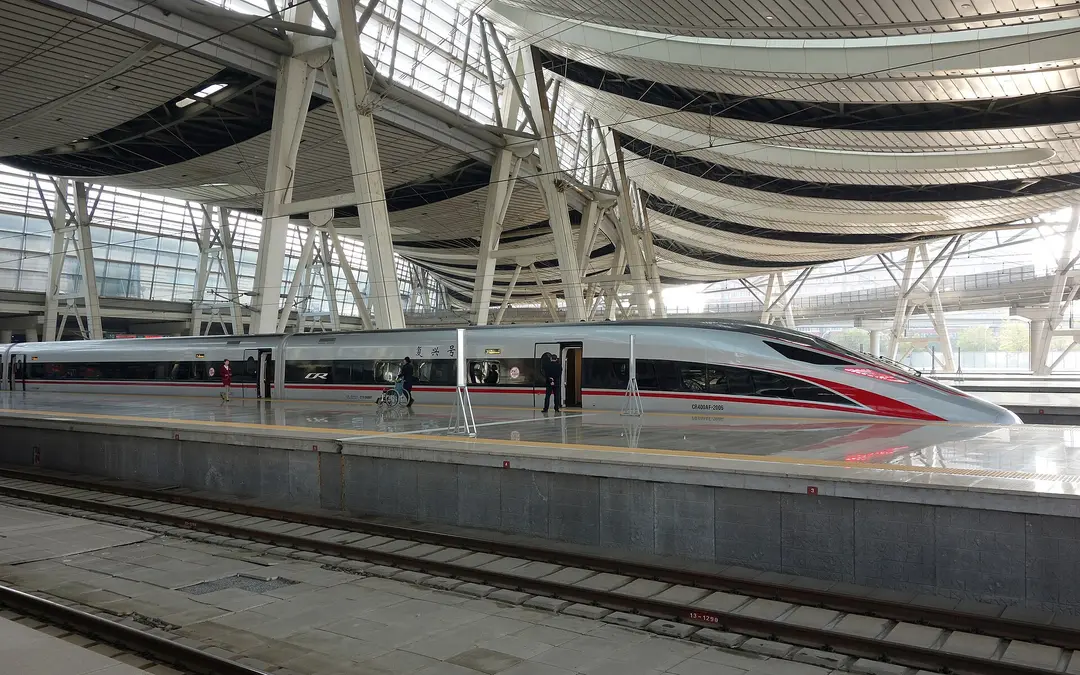
The site is open to visitors as one museum with two areas: the halls over the three pits, and Lishan Garden around the burial mound, linked by a free shuttle. Tickets, booking with a passport, and the metro and bus route are on our Terracotta Army visitor page. From Beijing, Xi’an is about four hours by high-speed train, which is how most first-trip itineraries reach it.
When were the Terracotta Warriors discovered?
In March 1974, farmers from Xiyang village digging a well struck pieces of clay figures, among them a head. National Geographic names Yang Zhifa as the farmer whose spade hit it. Archaeologists spent more than a year surveying before confirming a large pit, now Pit 1. Pits 2 and 3 were found in the spring of 1976.
UNESCO listed the mausoleum as a World Heritage Site in 1987. In 1980 archaeologists found two bronze chariots, each pulled by four bronze horses, in a pit near the mound; they are now shown at Lishan Garden.
How were the Terracotta Warriors made?
The figures were made from local clay. Workers kneaded it, pressed it into moulds for some parts and built up others, such as the torso, from coils. Heads, arms, hands and bodies were made separately, fired in kilns, then joined.
Production was not one factory line. National Geographic describes small teams working in parallel, each under a master, and some pieces carry the names of workshops or foremen, an early form of quality control. Weapons came from separate armories and were handed out afterwards. Britannica notes that the bronze blades were cast from an alloy of 13 elements and many are still sharp.
The finished figures were coated in lacquer and painted, then carried down into the pits. Timber roofs were laid over the corridors and buried under earth; Britannica notes that many figures were found broken beneath the collapsed roofing.
Are all the Terracotta Warriors different?
No two have been found exactly alike. The faces seem to start from a limited set of basic forms, perhaps about ten, and craftsmen then added clay to change cheekbones, beards, moustaches and expressions. Hairstyles, headgear and armor change with rank, so a general is easy to tell from a foot soldier.
In 2014 a team from University College London and the museum scanned 30 ears in 3D and found that no two matched, with variation similar to a human population. That supports the idea that the figures were portraits of real soldiers, though the team said many more ears would have to be measured to be sure. The figures contain no human remains.
How tall are the Terracotta Warriors?
They are life-size. Most stand roughly 1.75 to 2 m tall, with officers taller than ordinary soldiers and generals the tallest. Measurements published by a Xi’an travel company put the figures at 1.80–1.90 m including the base and topknot, and about 1.70–1.80 m without them. National Geographic describes many as standing about six feet and weighing about 450 pounds, roughly 200 kg.
Were the Terracotta Warriors painted?
Yes. They were once painted in bright reds, greens, purples and yellows, with black hair, pink faces and dark eyes. Almost all of that is gone. National Geographic reported that once a painted figure is exposed to Xi’an’s dry air, the lacquer under the paint starts to curl after 15 seconds and can flake off in four minutes. That loss is one reason excavation moves so slowly. The museum’s Pit 2 collection includes a kneeling archer that still carries visible paint.
Why were they made, and why hasn’t the tomb been opened?
No surviving text from the period mentions the army, so its purpose is inferred. The usual reading is that it was meant to protect and serve the emperor after death, facing outward from the tomb as a living army would.
The burial chamber under the 51-meter mound has never been opened. The Han historian Sima Qian, writing about a century later, said it held rivers of mercury. In 2016, Chinese and Swedish researchers measured mercury vapor over the mound with laser radar and found levels well above the local background. Their 2020 paper in Scientific Reports says this adds credibility to his account, though it does not prove rivers of mercury. The chamber remains unexcavated, and the reason most often given is preservation: the warriors’ paint shows how fast exposure can destroy what has survived underground.
Plan the visit itself with our Terracotta Army page, and add an evening in the Muslim Quarter for Xi’an’s food. A Hosted China guide can take you through the pits and explain what you are looking at.